SAP Data Migration Services
Welcome to our SAP data migration services! As enterprises grow, they may need to migrate SAP data between production versions. Our data migration services help organizations move SAP data smoothly across versions. We start with an in-depth analysis of your current SAP system and its data to identify the right migration strategy - including detailed assessment of data quality, completeness, and accuracy to improve migration quality and predictability.
Data migration is one of the highest-risk elements of any SAP project. Poorly migrated master data, incomplete open items, or inaccurate opening balances undermine user confidence, distort period-end reporting, and can delay go-live for weeks. Based on the analysis results, our experienced team of SAP consultants will create a data migration plan tailored to your organization's specific needs and requirements. We will work closely with you to drive the migration forward on the agreed schedule while minimizing business downtime and disruption, and we treat data quality as a shared responsibility between IT and business owners rather than a purely technical exercise.
Our data migration process includes the following workflows, each with defined inputs, acceptance criteria, and documented handovers to the business:

Our SAP data migration services help organizations migrate SAP data from one production version to another while minimizing business downtime and disruption. By leveraging our expertise in data migration, we help organizations achieve a smooth migration process, reduce business risk, and improve operational efficiency — and we carry this same discipline across ECC-to-S/4HANA conversions, new implementations, and system consolidations.
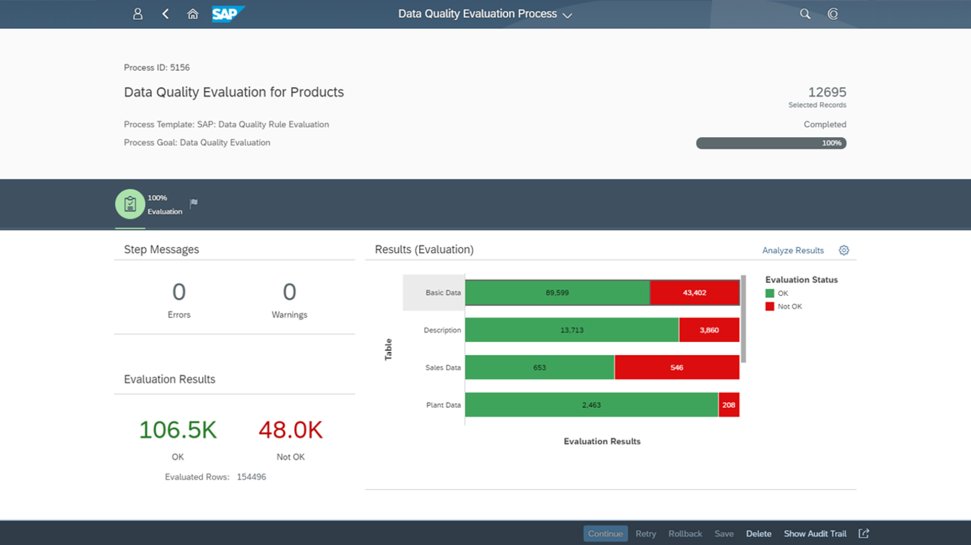
Data migration toolkit value. To accelerate repeatable migration work, we apply a standardized toolkit that covers template preparation, automated validation, and migration management. The template module provides prebuilt loaders for objects such as G/L accounts, cost centers, vendors, customers, material masters, open items, and balances, so teams do not rebuild interfaces for every project. The validation engine runs consistency checks before each load pass, flagging missing mandatory fields, invalid references, and duplicate records. The migration dashboard gives project managers a live view of object volumes, error counts, and progress by wave, making cutover decisions fact-based rather than manual spreadsheet tracking. Reusing these assets means shorter preparation cycles, fewer defects discovered late, and a predictable cost structure that clients can plan around with confidence.
Cutover and business downtime. Migration risk is concentrated in the cutover window, when the source system stops updating and the target must take over within a fixed business or financial deadline. We plan cutover as a sequence of ordered waves — first organizational and master data, then balances and open items, finally transactional delta — with each wave tested and signed off before the next begins. Delta loads are rehearsed so the final period between source freeze and go-live is predictable. This phased approach protects period-end close, prevents duplicate or missing open items, and gives finance a controlled, reversible path into the new system rather than a single all-or-nothing load.
Quality assurance. A migration is only successful if the loaded data is trusted by the business. We maintain explicit mapping rules between source and target fields, document transformation logic, and define an exception-handling process that routes ambiguous records to data owners for resolution instead of blocking the entire load. Historical data is handled according to retention and archiving policy: open and relevant balances migrate with the cutover, while closed legacy periods are archived or reconciled rather than force-loaded into the new system. This approach protects system performance after go-live and gives auditors a complete, traceable record of what moved, how it was transformed, and who approved it. Before each production load we run reconciliation reports that compare source and target totals by company code, account, and subledger, so finance signs off on the numbers rather than relying on a technical "load completed" message.